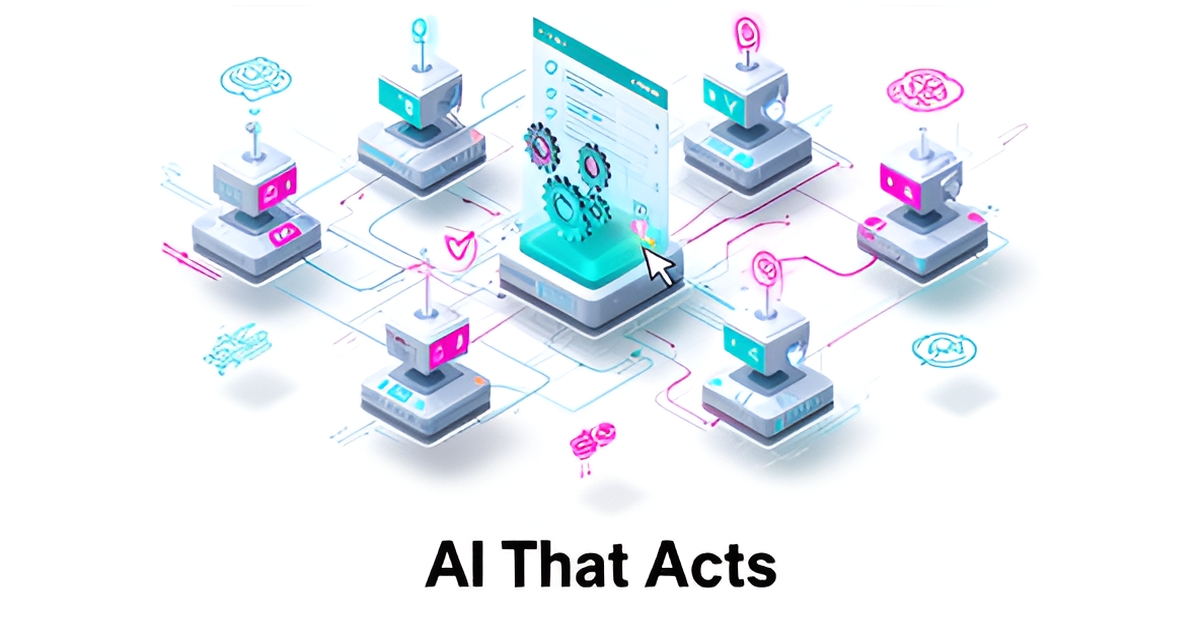
Agentic AI Definition: What It Is & How It Works
What is agentic AI? Get the clear agentic AI definition, see how it differs from generative AI, and explore real autonomous AI agent examples in business.
Agentic AI Definition: What It Is & How It Works
Key Facts
- Agentic AI operates in three phases: planning, function calling, and memory, according to IBM's framework.
- The ReAct loop, Think, Act, Observe, is the most widely adopted agent implementation pattern, per Unstructured.io's analysis.
- 79% of US executives say AI agents are already adopted, yet only 7% reached operationalizing, per Market.us research.
- Capgemini found only 14% of organizations have actually deployed AI agents, reported by Fortune Business Insights.
- Cisco projects agentic AI will handle 68% of vendor customer-service interactions by 2028, according to Fortune Business Insights.
- Tetra Pak compressed certain agentic workflows from days to hours, per MarketsandMarkets reporting.
- Memory is the pillar that separates stateless tools from systems that improve with use, per Unstructured.io's four-pillar framework.
Why Chatbots Hit a Wall (and What Businesses Actually Need)
You installed a chatbot. It answers questions politely, quotes your pricing page, and then... waits for a human to do the actual work. That's the wall most businesses hit with generative AI, and it's exactly why the agentic AI definition matters: agentic AI marks the shift from systems that respond to systems that act. IBM describes it as programs that "autonomously perform a task on behalf of a user," operating in a loop of planning, tool use, and memory rather than single-shot answers.
The gap is real, and the numbers show it. A MarketsandMarkets analysis frames the entire category as the move from assistive tools to autonomous workflow execution. Meanwhile, a peer-reviewed Elsevier taxonomy draws a sharp line between two things buyers often confuse:
- AI agents: modular systems driven by LLMs for task-specific automation, like a chatbot that answers from your FAQ page.
- Agentic AI: a paradigm defined by multi-agent collaboration, dynamic task decomposition, persistent memory, and coordinated autonomy.
- Generative AI: the precursor. It provides the reasoning foundation; agentic systems build tool integration and planning on top of it.
Put simply: a chatbot generates text. An autonomous AI agent perceives a goal, breaks it into steps, calls the tools it needs, checks its own work, and finishes the job. If a customer asks "can I book Thursday at 2?", the chatbot says yes and hands the task to a human. The agentic system checks real calendar availability, creates the booking, sends the confirmation, and logs the lead. Same question, fundamentally different outcome.
This is why adoption is accelerating even while most deployments are still immature. Per adoption research compiled by Market.us, 79% of US executives say AI agents are already in place at their organizations, yet only 7% have reached the operationalizing stage. Businesses want agents that execute; most are still stuck with tools that only talk. The bottleneck, as Mordor Intelligence notes, is trust: skills and governance constrain what buyers will delegate, which is why human-in-the-loop approval gates matter so much in practice.
You can see the distinction in everyday business tools. An AI receptionist that answers calls and books appointments into a real calendar is agentic; a website FAQ widget that only recites answers is not. The same logic applies to content systems that research, verify claims, and publish without a human writing a word.
If you're weighing tools, judge them the way MarketsandMarkets suggests: measure agent quality through actions, not responses. That single test separates the systems worth paying for from the ones that just talk.
The Agentic AI Definition, Broken Down: Perception, Planning, Memory, Tool Use
Agentic AI is a class of software that pursues a goal on its own, deciding what to do next instead of waiting for a prompt at every step. The clearest way to define it comes from Unstructured.io's four-pillar framework: an LLM acts as the reasoning engine, and the system autonomously pursues complex goals by iteratively perceiving its environment, forming a plan, and executing actions through available tools.
IBM describes the same machinery as a three-phase loop: plan, function calling, memory. The agent devises a plan with steps for a complex task, uses function calling to reach external tools like APIs, databases, and web searches, then stores what it learns from feedback so the next run starts smarter.
Here's what each pillar actually does:
- Perception, the agent reads its environment through multi-modal inputs (text, documents, web pages, call transcripts) rather than a single prompt.
- Planning, it decomposes a goal into steps and chooses an approach, often using the ReAct pattern: Think, Act, Observe, repeat.
- Memory, short-term context plus long-term storage, which is what turns a stateless tool into a system that improves with use.
- Tool use, function calling that connects reasoning to real systems: APIs, MCP servers, databases, and other agents.
The ReAct loop (Reason-and-Act) is the most widely adopted implementation pattern for building effective agents, according to Unstructured.io's breakdown. The agent thinks about the next step, acts through a tool, observes the result, and folds that observation back into its reasoning. An alternative, Plan-and-Execute, generates the full sequence of tool calls up front: more efficient, less adaptable when reality intervenes.
Not every "agent" deserves the name. Unstructured.io lays out a six-level autonomy spectrum, from Level 1 (hard-coded scripts) through Level 5 (state machines with real cycles and loops, the first genuinely agent-like behavior) to Level 6, fully autonomous systems where the guardrails come off. Most production systems today sit at Levels 3 to 5, which is why human-in-the-loop approval gates and kill switches show up in serious deployments.
Memory is the pillar people underestimate. It's "the difference between stateless tools and systems that improve with use," and MarketsandMarkets frames memory and context management as what turns stateless agents into persistent enterprise workers. A tool that forgets every interaction is a vending machine. An agent that remembers your last call, your preferences, and your open quote is closer to a colleague.
That distinction matters in practice. When we build an AI receptionist for a service business, the agent answers the call, captures the details, and logs a transcript the owner can act on later, all without a human prompting each step. The definition only becomes real when the loop closes and something actually gets done.
Agentic AI vs. Generative AI vs. Traditional Automation: What's the Difference?
A rules engine, a chatbot, and an autonomous agent can all sit on the same large language model, and still behave nothing alike. What separates them is what happens between the request and the result.
Generative AI is the precursor: prompt in, content out. A peer-reviewed review in Information Fusion frames generative AI as "a precursor providing the foundation," with AI agents advancing through tool integration, prompt engineering, and reasoning enhancements. Traditional automation runs at the other end, executing pre-written if/then logic that behaves the same way no matter how the request is phrased.
| Dimension | Traditional automation | Generative AI | Agentic AI |
|---|---|---|---|
| Core logic | Pre-written if/then rules | Model output from a prompt | Dynamic task decomposition and coordinated autonomy |
| Input | A structured event or field | A natural-language prompt | A goal, plus context the agent gathers itself |
| Output | One defined action | Content | A sequence of actions across tools |
| Memory | None by default | Session context | Persistent memory across runs |
| Tool use | Hard-coded integrations | Rarely | Function calling to APIs, databases, other agents |
| Autonomy level | Level 1 | Level 2 | Levels 5-6 |
The dividing line is the loop. Unstructured.io's four pillars, reasoning, planning, memory, and tool use, describe a system that perceives its environment, forms a plan, acts through tools, then learns from what it stored. The most widely adopted implementation pattern is ReAct, an iterative Think, Act, Observe loop, which the peer-reviewed literature also cites as a remedy for agent brittleness. On the six-level autonomy spectrum, hard-coded logic sits at Level 1, a single LLM call at Level 2, and genuine agent-like behavior appears only at Level 5, where a state machine runs cycles and loops.
The same peer-reviewed taxonomy names four traits that mark the shift from ordinary AI agents to agentic AI:
- Multi-agent collaboration, where agents work as a coordinated team
- Dynamic task decomposition, where the agent splits a goal into its own steps
- Persistent memory, carrying state across runs
- Coordinated autonomy, acting without a step-by-step script
Multi-agent or single-agent? The market data genuinely disagrees. Mordor Intelligence puts multi-agent systems at 53.81% of 2026 revenue with a 43.75% CAGR, while Fortune Business Insights reports single agentic AI at 58.12% share in 2026, and MarketsandMarkets says single-agent systems remain dominant. Market.us counted multi-agent at 66.4% of segment share in 2024. Read together, the honest conclusion is that both architectures are scaling, and the winner depends on the workload rather than the hype cycle.
AI Business Sites runs this pattern as a managed service: a content engine built from 12 specialized agents, human approval gates before anything customer-facing ships, and an AI receptionist that answers a dedicated phone line 24/7. Our guide to an AI website builder for small business covers the setup side, and we also wrote how to get cited by ChatGPT if you want that content surfacing inside AI answers.
Ready to put agentic AI to work in your business? Explore AI Business Sites' AI-powered tools and see how autonomous agents can handle your website, bookings, and customer conversations. You can also book a free 30-minute strategy call with no obligation, and cancel any time with 30 days' notice.
What Agentic AI Looks Like in the Real World (Examples and Market Reality)
The gap between agentic AI's promise and its practice shows up in the numbers. PwC found that 79% of US executives say AI agents are already adopted in their organizations, yet Capgemini reports only 14% of organizations have actually deployed them. That spread tells you most of what you need to know about where the market really sits.
Named deployments show what "working" looks like. Commerzbank runs an agent called AVA, Sanofi and EY have built agentic systems into internal workflows, and Tetra Pak compressed certain processes from days to hours. Cisco projects agentic AI will handle 68% of vendor customer-service interactions by 2028. These are real systems doing real work, not demos.
Market sizing deserves honesty rather than a headline number. Research firms disagree sharply:
- Market.us projects $5.2B in 2024 growing to $196.6B by 2034
- Fortune Business Insights estimates $7.29B in 2025 reaching $139.19B by 2034
- Mordor Intelligence forecasts $9.89B in 2026 climbing to $82.27B by 2032
The spread is enormous, and it reflects genuine uncertainty about how fast enterprises will move from pilots to production.
The real bottleneck isn't capability. It's trust, governance, and human oversight. Mordor Intelligence notes that skills and trust constrain which tasks buyers will delegate, and Unstructured.io argues that higher autonomy levels require sandboxing, human-in-the-loop approval gates, and kill switches. That's why most successful deployments keep a person in the approval loop rather than removing them.
For a small business, this looks less like a robot running the company and more like a managed system where the AI drafts, books, answers, and follows up while the owner approves what matters. A managed AI receptionist that logs every call with a transcript, or a site built on an AI website builder for small business, follows the same principle: autonomy with a human checkpoint. That's the model AI Business Sites runs, and it's the model the research keeps pointing toward.
Ready to put agentic AI to work in your business? Explore AI Business Sites' AI-powered tools and see how autonomous agents can handle your website, bookings, and customer conversations.
How to Put Agentic AI to Work Without Building It Yourself
Most small businesses don't need another definition of agentic AI. They need the phone answered at 7pm and the quote out the door before the customer calls the next company on Google.
When agentic AI is built for you, it shows up as a loop that keeps running while you're on a job site: it perceives the request, plans the next step, calls tools like your calendar and CRM, and remembers what happened so the next customer gets a faster answer. In practice, that looks like this:
- Answers calls and chats. A voice agent on your site talks with visitors in their browser, and the AI receptionist add-on ($199/month) picks up real inbound calls on a dedicated number 24/7, books appointments, and logs every transcript and summary to your leads inbox.
- Drafts the quote from the call. The assistant reads the transcript and proposes line items with services, materials, quantities, tax, and a valid-until date, then sends the customer a one-tap approval page with a typed-name signature.
- Books the job. An approved quote becomes a job card on the board, lands on the calendar, and shows up in the technician's day view with Start, On My Way, and Finish buttons that trigger customer notifications.
- Collects the invoice. Card payment runs through your own Stripe account, so the money goes straight to you, with automated day-3, 7, and 14-day reminders for anything unpaid.
- Requests the review. Once the job closes, the review request goes out with your Google link, so the loop finishes instead of stalling.
The human stays in the loop. Customer-facing actions can sit behind an approval queue, and that's not caution for its own sake. According to survey data on enterprise agent adoption, 40% of organizations say more than 40% of their AI pilots stall before reaching production, 78% struggle to build the connected data foundation an agent needs to actually act, and 66% of adopters who get that far report measurable value through higher productivity. A Fortune Business Insights summary of Cisco's projection puts agentic AI at 68% of all customer service and support interactions with technology vendors by 2028.
For a small business, that is the difference between a website that sits there and a system that answers, quotes, schedules, invoices, and asks for the review. AI Business Sites builds it as a done-for-you system: a custom site live in seven days with 85+ pages, then a managed AI back office at $497 a month after a $1,497 setup. If you've been comparing an AI website builder for small business, the difference is that you configure nothing and own everything, including the code, content, data, and domain, on month-to-month terms with 30 days' notice. The content engine also publishes service pages, location pages, and comparison pages every month, structured so AI engines can quote them accurately, which is worth understanding if you want to know how to get cited by ChatGPT.
Ready to put agentic AI to work in your business? Explore AI Business Sites' AI-powered tools and see how autonomous agents can handle your website, bookings, and customer conversations. Or book a free strategy call and we'll look at your website, your calls, and your follow-up together. Thirty minutes, no obligation, no pitch.
Frequently Asked Questions
What is the actual difference between agentic AI and a standard chatbot?
How does agentic AI actually work under the hood?
Is agentic AI just a more advanced version of generative AI?
Why are most AI agent projects failing to reach production?
Do I need to build an AI agent from scratch to use it for my business?
What are some real-world examples of agentic AI in action?
From Definitions to Real Business Results
The agentic AI definition comes down to one shift: systems that respond became systems that act. Perception, planning, memory, and tool use turn an LLM from a text generator into an autonomous agent that books the job, drafts the quote, and closes the loop, while generative AI and traditional automation stop at the answer. The market reflects the gap: 79% of executives say AI agents are already in use, yet only 7% have operationalized them, because trust, governance, and human oversight are the real bottleneck. For a small business, the practical next step isn't building an agentic stack yourself, it's finding a system where agents handle the calls, quotes, and follow-up while you approve what matters. That's the model AI Business Sites runs as a done-for-you service. Ready to put agentic AI to work in your business? Explore AI Business Sites' AI-powered tools and see how autonomous agents can handle your website, bookings, and customer conversations.