The Per-Seat Tax Is Under Attack. Flat Pricing Is What Comes Next.
A roofing CRM just killed per-seat pricing for its customers. Here's why that matters for every small service business still paying per seat and per add-on.
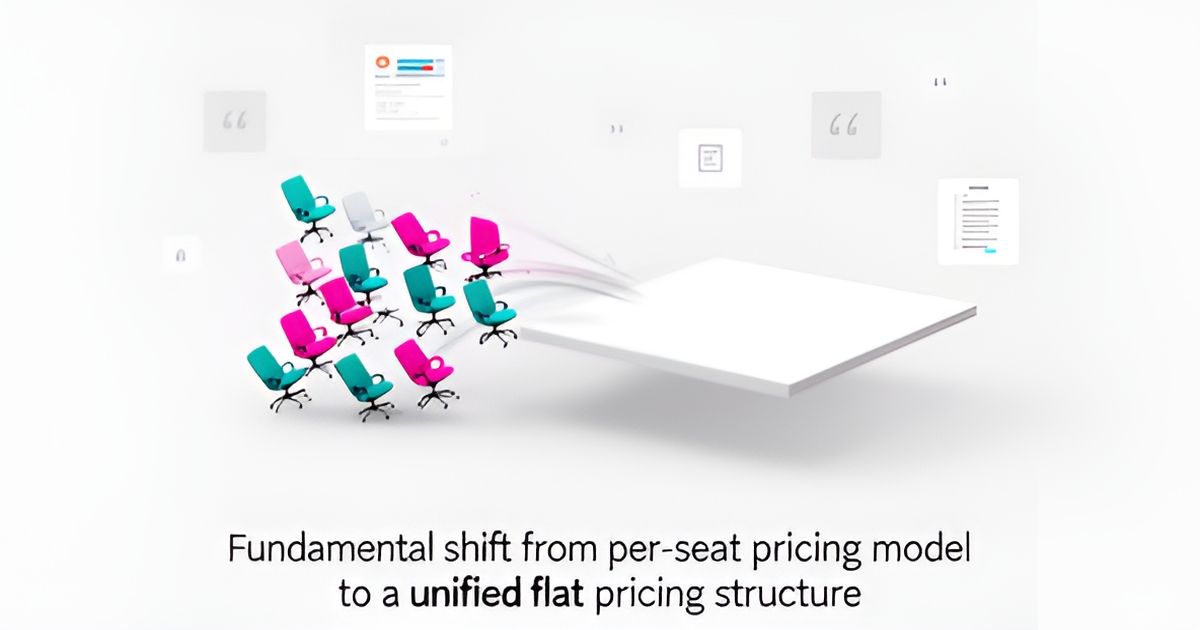
Roofr's event covered several launches: a roofing-specific AI receptionist that qualifies leads, books appointments, and routes urgent calls, plus updates to its website builder, estimating, and proposals tools. But the pricing announcement is the part with wider implications. Roofr explicitly positioned unlimited seats as an attack on the per-seat model common among CRMs, the same model that Jobber, Housecall Pro, and ServiceTitan customers know well. The framing matters because Roofr is a serious vendor, and it just told the market that charging for each additional user is a grievance worth building a marketing campaign around. When one vendor says it out loud, others have to respond. When the message lands with contractors, the whole category shifts. There's a second signal in the launch too. Roofr pitched itself as an all-in-one platform replacing what it called a patchwork of disconnected point tools: estimating software, proposal software, payment software, and an answering service, each built for other industries and retrofitted for roofing. That's the same consolidation argument small business owners have been making privately for years. Six subscriptions that don't talk to each other isn't a tech stack. It's a part-time job.
Per-seat pricing made sense when software companies sold tools that each employee had to log into and learn. Every seat was a real cost: onboarding, support, training. The model stuck long after the economics changed. What changed is AI. Building and maintaining software is dramatically cheaper than it was five years ago. More than a third of new startups are now solo-founded, according to reporting synthesized by UX Collective this month, because a single person with AI tooling can produce what used to require a team. Anthropic's CEO has put 70 to 80 percent odds on a one-person billion-dollar company arriving by the end of this year, and investors are openly running betting pools on the milestone. When the cost of building falls that far, charging per user stops reflecting cost and starts reflecting habit. Vendors keep the per-seat model because it's profitable, and customers pay it because the alternatives were scarce. Now the alternatives aren't scarce.
Seats are only half the bill. The other half is feature gates. Field-service software has a long history of charging extra for the things a service business actually needs: review requests, e-signature on quotes, pipeline management. You buy the base subscription, then discover that closing the loop from quote to invoice to review costs more, every month, on top of what you're already paying. Compare that to what a flat, all-inclusive model looks like in practice. AI Business Sites charges $1,497 one-time for a custom build with 85+ pages live in 7 days, then $497 per month for everything: hosting, a 24/7 chatbot and browser-based voice agent on the site, a CRM, 14+ new SEO content pieces every month, and a jobs module that runs the whole quote to job to invoice to review loop. Quotes get drafted by the AI from the call, customers approve and sign them online, the job lands on the calendar, the invoice carries its own pay page with card payment through the business's own Stripe account, and the review request goes out after payment. There are no per-seat fees and no add-on charges for e-signature or review tools, because they're not extras. They're the work. The contract terms follow the same logic: month-to-month, cancel with 30 days' notice, and if you leave, the code, content, data, and domain go with you. Pricing confidence and ownership confidence reinforce each other. A vendor that has to keep you by doing the work doesn't need a lock-in clause.
If you're reviewing your software costs this quarter, the Roofr launch gives you a useful checklist. First, ask what a new employee costs. Not in wages, in software. If adding a technician means adding $50 to $100 a month across three subscriptions, you're paying a hiring tax. Second, ask what the complete loop costs. Map the full cycle of your work: lead comes in, quote goes out, customer signs, job gets scheduled, invoice gets paid, review gets requested. Then find every line item on your bills that touches that cycle, including add-ons. The gap between your base subscription and the real total is the honest number. Third, ask who answers the phone when you can't. Most callers don't leave voicemail anymore; they call the next business on Google. AI answering has become a real category this year, and the offerings differ in ways worth understanding. A voice agent embedded on your website, which visitors talk to in their browser, is one thing. A dedicated phone number that an AI answers 24/7, books appointments on, and logs with transcripts, is another. Make sure any vendor you talk to explains which one they're selling you and what it costs. Fourth, ask what happens to your data if you leave. You should own your customer list, your content, and your reviews process outright. If a vendor's answer involves export fees or locked proprietary formats, that's information.
The per-seat model won't disappear overnight, but its defenders now have to argue for it, and that's new. Expect more vendors to follow Roofr into unlimited seats, and expect the battleground to move to what's included: whether reviews, quoting, invoicing, and content are part of the platform or priced as extras. For a small service business, the practical takeaway is simple. Software pricing is negotiable by market pressure, and the pressure is finally on your side. The vendors consolidating everything into one flat price are betting they can win by keeping you through the quality of the work. That's a bet you benefit from either way.