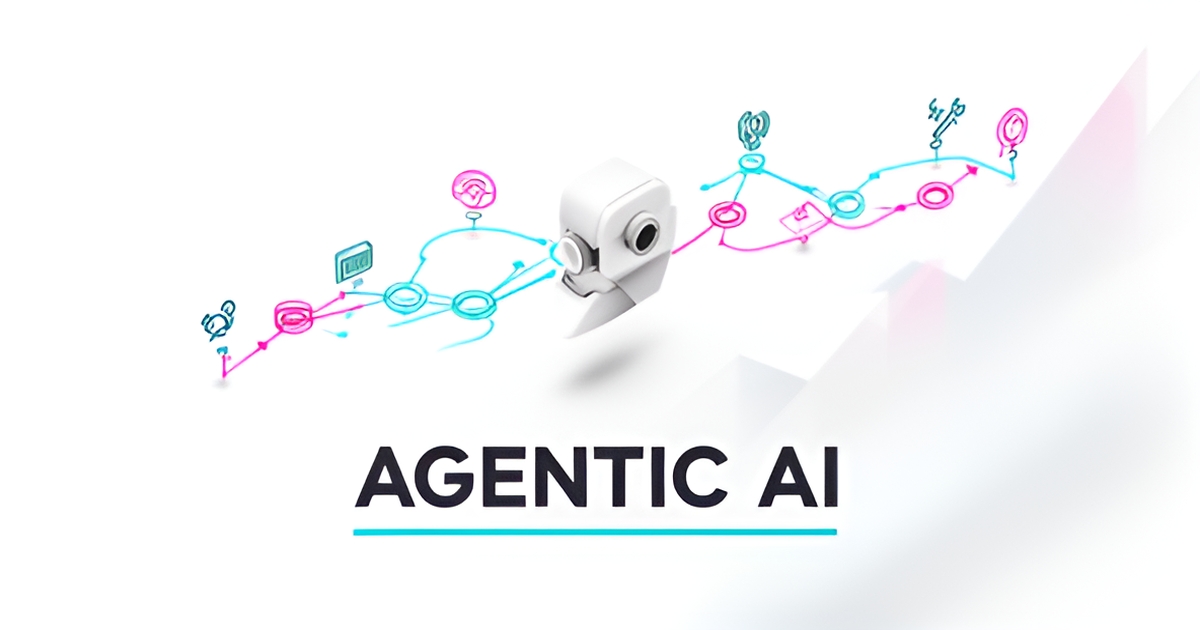
Agentic AI Definition: What It Is & Key Examples
What is agentic AI? Get a precise agentic AI definition, see how it differs from traditional AI, and explore real autonomous AI agent examples with numb...
Agentic AI Definition: What It Is & Key Examples
Key Facts
- The agentic AI market is projected to grow from USD 7.29 billion in 2025 to USD 139.19 billion by 2034, per Fortune Business Insights.
- Klarna's AI assistant handled 2.3 million conversations in its first month, doing the work of 700 full-time agents, per MarketsandMarkets.
- Only 14% of organizations have deployed AI agents, with 23% still in pilots and 61% exploring, per Capgemini research.
- Adoption surveys swing wildly from 23% to 79% because 'AI agent' has no fixed industry definition, per definitional research.
- A UC Berkeley study found seven open-source multi-agent frameworks failed 41% to 86.7% of tasks, with 14 distinct failure modes, per compiled benchmark data.
- METR benchmarks show frontier models complete 70-minute tasks at 80% success but 12-hour tasks at only 50%, per benchmark research.
- MCP TypeScript SDK downloads grew 7.3x year-over-year to 203.3 million, with over 10,000 active public MCP servers, per agentic AI statistics.
Why 'AI Agent' Is Everywhere but Hard to Pin Down
You've seen the term "AI agent" on every vendor page this year. The trouble is, nobody agrees on what it means, and that vagueness is costing buyers real money.
Ask two analysts to count adoption and you get two different worlds. Definitional research shows the U.S. Census finds 23% of firms using any AI while PwC reports 79% of executives saying agents are "being adopted." The gap isn't adoption speed. It's that some surveys let respondents decide what counts, which means a basic chatbot qualifies.
That looseness has consequences when you're evaluating vendors. A tool that answers FAQs from a document is doing retrieval. An autonomous AI agent plans a multi-step task, calls external tools mid-task, and adapts when the world pushes back. Only one of those will close your quote-to-invoice loop without you babysitting it.
Why does this matter right now? Because the market is growing at roughly 40% CAGR regardless of which firm you ask. Fortune Business Insights sizes agentic AI at USD 7.29 billion in 2025 rising to USD 139.19 billion by 2034. MarketsandMarkets projects USD 205.88 billion by 2033 from a larger base. Money at that scale attracts marketing, and marketing blurs definitions on purpose.
McKinsey takes a strict line: an agent plans and executes multi-step workflows on its own. Other surveys let the respondent interpret the term. That's why you'll see "agentic AI" attached to everything from a scripted IVR to a research system that runs overnight. You need a definition you can hold a vendor to.
A few signals that the hype outran the practice:
- Only 14% of organizations have deployed AI agents, with 23% still in pilots and 61% exploring, per Capgemini's research.
- METR benchmarks show frontier models completing 70-minute tasks at 80% success but 12-hour tasks at only 50%, per compiled benchmark data.
- A UC Berkeley study found seven open-source multi-agent frameworks failing 41% to 86.7% of tasks, with 14 distinct failure modes.
The pattern is consistent: reliability, not capability, is the gap. The plumbing (protocols like MCP and A2A) is spreading faster than the practice of running agents well.
So here's the working definition we use, and the one we build against at AI Business Sites: agentic AI is a system that perceives its environment, plans multi-step work, calls tools to act, and adapts based on results, without constant human input. The sections below break that into characteristics you can test, and examples with real numbers behind them. If you want the same agentic thinking applied to your own site and back office, explore how AI Business Sites leverages agentic principles to automate your business workflows.
Agentic AI Definition: What Separates Agents from Chatbots and Automation
Ask ten vendors what agentic AI means and you'll get ten different answers, which is exactly why a precise definition matters right now.
Here's the one worth using. Fortune Business Insights defines agentic AI as "a new generation of intelligent systems capable of autonomous decision-making and adaptive execution across complex, distributed digital ecosystems." DataCamp puts it more plainly: an AI agent is a software system that senses its environment, analyzes data, makes decisions, and acts to achieve goals without constant human input. Strip away the jargon and you get a simple test. If the system can plan a multi-step task, use tools to complete it, and adjust when reality doesn't match the plan, it's agentic.
What actually makes an agent an agent
DataCamp breaks every AI agent down into four components, and they're a useful checklist for judging whether something deserves the label:
- Perception: the agent collects input from its environment, whether that's a customer message, a database query, or a scraped web page.
- Decision-making: it analyzes that data using algorithms or large language models (LLMs) to decide what to do next.
- Action: it acts, updating systems, calling tools, or producing outputs, rather than just suggesting them.
- Learning: it improves from feedback over time instead of repeating the same mistake forever.
Under the hood, most agentic frameworks run on the ReAct pattern (Reasoning and Acting), a Thought → Action → Observation loop where the model reasons through a problem, takes a step, checks the result, and continues. Because the agent retrieves real information to verify its claims, this loop also reduces hallucination. It's the backbone of frameworks like LangChain and CrewAI.
Agentic AI vs traditional AI: the honest comparison
The distinction comes down to how each system handles the unexpected. Traditional automation handles simple workflows but struggles with complexity and unpredictability. Agents can analyze information, make decisions, and adapt without a human babysitting every step. A rules-based chatbot follows a script; an agent rewrites its own plan mid-task.
MarketsandMarkets describes the shift enterprises are making as moving "beyond copilots" toward agents that complete defined tasks across multiple systems, follow business rules, and escalate exceptions when required. That last part matters. A copilot drafts an email and waits. An agent sends it, logs the reply, updates the CRM, and only loops in a human when something looks wrong.
One caveat that separates serious coverage from hype: "AI agent" has no fixed industry definition. Some surveys count a basic chatbot as an agent, which is why adoption figures swing wildly, from 23% of firms to 79% depending on who's asking. When you evaluate vendors (or build your own workflows), apply the four-component test above rather than the label on the box.
This is the standard we hold ourselves to at AI Business Sites, where our content pipeline runs twelve specialized agents (research, drafting, claim verification, citations, schema) coordinated as a production system, with human approval on anything customer-facing. That combination of tool use, planning, and human-in-the-loop governance is what agentic AI looks like when it's actually working. If you want to go deeper on visibility in AI-driven search, our guide on how to get cited by ChatGPT covers the practical side.
How Agents Actually Work: The ReAct Loop and Multi-Agent Systems
Under the hood, most autonomous AI agents run on a surprisingly simple loop. It's called ReAct, short for Reasoning and Acting, and it underpins popular frameworks like LangChain and CrewAI.
The loop has three steps: Thought, Action, Observation. The agent first reasons about what to do next, then takes an action, usually calling an external tool like a search engine, database, or API. It then observes the result and reasons again. IBM describes ReAct agents as using an LLM "brain" to coordinate this reasoning and action cycle until the task is complete.
That tool use matters more than it might sound. When an agent can retrieve real information mid-task and verify facts against it, it relies less on what the model merely "remembers," which is where hallucinations come from. According to a technical breakdown of the ReAct framework, combining chain-of-thought reasoning with external tool use is exactly what reduces hallucination in practice. An agent that checks a live source before stating a price is fundamentally more trustworthy than a chatbot guessing from training data.
The next evolution is orchestration. Agentic systems have moved from single monolithic agents (think FAQ chatbots) to loosely coupled systems and now to orchestrated multi-agent setups with structured coordination, a progression documented in an arXiv paper on agentic architectures. Two protocols formalize how these systems talk to each other:
- Model Context Protocol (MCP) standardizes how agents access external tools and data sources.
- Agent-to-Agent (A2A) governs peer coordination and delegation between agents.
The plumbing is spreading faster than the practice. There are now more than 10,000 active public MCP servers as of December 2025, and MCP TypeScript SDK downloads grew 7.3x year-over-year to 203.3 million, per agentic AI statistics compiled from 42 primary sources. Today, single agentic AI still holds a 58.12% market share, but multi-agentic AI is forecast to grow at a 46.30% CAGR, according to Fortune Business Insights.
Here's the honest caveat: the current bottleneck is reliability, not capability. METR benchmarks show Claude Opus 4.6 completing 12-hour tasks at only 50% success, while 70-minute tasks hit 80%. A UC Berkeley study of seven open-source multi-agent frameworks found they failed 41% to 86.7% of tasks, with 14 distinct failure modes. Without orchestration, even capable agents risk duplicated effort, logical inconsistency, or autonomy that drifts from the objective.
That's why mature deployments pair agents with human-in-the-loop governance. At AI Business Sites, for example, the content pipeline runs 12 specialized agents (research, drafting, claim verification, citations, schema markup) with approval gates before anything publishes. The loop does the work; the human keeps it honest.
Real-World Agentic AI Examples with Numbers
Klarna's OpenAI-powered assistant handled 2.3 million conversations in its first month, covering two-thirds of the company's customer service chats. That single deployment did the work of roughly 700 full-time agents and contributed an estimated $40 million profit improvement in 2024, according to MarketsandMarkets research. Real production numbers like these are why agentic AI examples matter more than definitions alone.
Google Cloud organizes real-world agentic deployments into six agent types, and the case studies below map cleanly onto that taxonomy.
- Customer agents: Klarna's assistant and Intercom's Fin for Gamma, which handles 100% of inbound support, resolves 75% of issues end-to-end, and logs 18,000+ resolutions per month at an 84% CSAT score.
- Employee and data agents: Cox Automotive runs 17 agentic solutions in production, including FleetMate, which cut repair-estimate turnaround from 8–48 hours down to 30 minutes.
- Creative and code agents: Valeo reports that more than 35% of its code is now AI-generated, while Toyota has eliminated over 10,000 man-hours per year through agentic workflows.
- Security, data, and operations agents: Team Liquid used SAP Joule agents to analyze 10+ million games, saving roughly $250,000 annually, while Wiley's Salesforce Agentforce deployment improved case resolution by over 40% with 213% ROI.
The pattern across every example is the same: the agent perceives a request, reasons about it, uses tools, and acts without waiting for a human to approve each step. That is the practical difference between agentic AI and traditional automation, which stalls the moment a workflow gets unpredictable.
The caveat worth keeping in mind: "AI agent" still lacks one fixed industry definition, which is why adoption surveys range from 23% to 79% depending on how the question is framed. Reliability, not raw capability, remains the limiting factor in high-stakes deployments. The businesses seeing results treat agents as supervised team members with human approval gates, not as fully autonomous replacements.
That governance-first approach is exactly what AI Business Sites applies to small business workflows: a multi-agent content pipeline, human-in-the-loop approvals, and a quote-to-invoice loop that runs with oversight at every step. If you want to see how agentic principles work in a business you actually run, book a free strategy call and we'll walk through it together.
What Agentic AI Means for Your Business Workflows
By now the definition should feel less like theory and more like a checklist. If a system can perceive input, make decisions, use tools, and learn from results, it's agentic. If it just answers questions in a chat window, it's a chatbot. That distinction matters more for a small business owner than for anyone else, because you don't have a team of engineers to babysit the difference.
The four components DataCamp outlines for AI agents (perception, decision-making, action, and learning) map directly onto what a working business system looks like in practice:
- Multi-agent pipelines, where specialized agents hand off work instead of one model doing everything badly. Research from an arXiv taxonomy paper shows agentic systems evolved from single monolithic chatbots into orchestrated multi-agent systems with structured coordination.
- Tool use, meaning the AI can actually do things: query a CRM, draft a quote, book a slot, publish a page. The ReAct pattern (Thought, Action, Observation) underpins most agentic frameworks precisely because it lets models verify facts with real information instead of guessing.
- Human-in-the-loop approval, so the agent drafts and the owner decides. MarketsandMarkets notes that buyers now prioritize agents operating "within defined business rules" over raw reasoning capability.
- Defined business rules, because without orchestration, even capable agents risk "duplication of effort, logical inconsistency, or unbounded autonomy."
This is also where the reliability gap shows up. A UC Berkeley study found seven open-source multi-agent frameworks failed 41% to 86.7% of tasks, and METR benchmarks show top models complete 12-hour tasks at only 50% success. Capability isn't the constraint. Governance is. That's why approval queues and confidence thresholds aren't bureaucracy; they're what make an agentic system safe to run a business on.
It's the difference we think about constantly at AI Business Sites. Our content engine runs 12 specialized agents (research, statistics, drafting, claim verification, citations, schema markup, SEO formatting) with a validation layer that won't publish a price it can't source. Every customer-facing draft, from review replies to quotes, lands in an approval queue with a confidence score. The assistant delegates to parallel sub-agents you can watch work in real time. That's an agentic pipeline, not a chatbot bolted onto a website.
If you want to see how these principles show up in search itself, our guide on how to get cited by ChatGPT breaks down why structured, verifiable content is what AI assistants pull from.
The takeaway is simple: when you evaluate any AI tool for your business, ask whether it plans, acts, and escalates, or whether it just talks. The first kind runs workflows. The second kind runs up your token bill. If you'd rather have someone who's already built the pipeline, the governance, and the approval queues walk you through what that looks like for your business, book a free 30-minute strategy call. No pitch, no obligation, just a real conversation about what you need.
Frequently Asked Questions
What is agentic AI in simple terms?
What's the difference between agentic AI and a chatbot or traditional automation?
How do AI agents actually work under the hood?
What are some real examples of agentic AI delivering results?
Is agentic AI reliable enough to run a business on?
Why do AI adoption statistics vary so wildly, from 23% to 79%?
The Definition That Saves You Money
The agentic AI definition comes down to one test: a true agent perceives, plans multi-step work, uses tools, and adapts when reality pushes back, without you babysitting every step. A chatbot answers. An agent acts. That distinction matters because the market is heading toward USD 139.19 billion by 2034 at roughly 40% annual growth, and marketing blurs definitions on purpose. When every vendor slaps "agentic" on the box, the four-component checklist, perception, decision-making, action, learning, is what protects your budget. The real-world examples prove the pattern: Klarna's assistant handled 2.3 million conversations in a month, and Cox Automotive cut repair estimates from days to 30 minutes. But reliability, not capability, remains the gap, which is why the winning deployments pair agents with human-in-the-loop governance. Your next step: run the checklist against every AI tool you're evaluating. Ask whether it plans, acts, and escalates, or just talks. If you'd rather see what agentic principles look like running a real business, a 12-agent content pipeline, approval queues, and a quote-to-invoice loop with oversight at every step, explore how AI Business Sites leverages agentic principles to automate your business workflows, or book a free 30-minute strategy call. No pitch, just a conversation about what you need.