From Missed Call to Paid Invoice: How AI Is Closing the Field-Service Loop
Most callers who hit voicemail never call back. New AI systems close the whole field-service loop, from call to quote to invoice to review, and the pricing models behind them are changing fast.
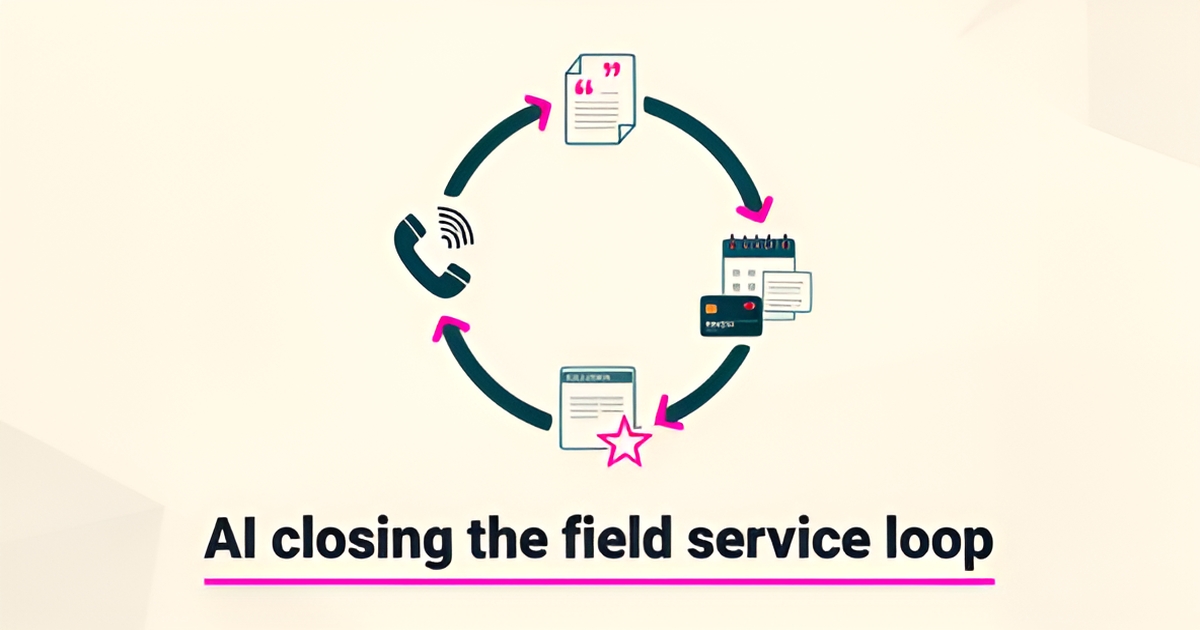
Strip away the industry jargon and every field-service business runs the same six steps: a customer calls, someone quotes the work, the job gets scheduled, the work happens, an invoice goes out, and hopefully a review follows. Most owners run this loop with a patchwork. A phone that rings unanswered half the day. Quotes typed up at the kitchen table at 9pm. A calendar app, a separate invoicing tool, and a review process that amounts to "I'll ask next time I see them." Each gap costs money. An unapproved quote is a job your competitor can win with a faster follow-up. An unpaid invoice is cash you already earned. A missing review is visibility you're handing to whoever has more of them.
The interesting development isn't that AI can write a quote. It's where the quote comes from. On platforms like AI Business Sites, which builds managed AI systems for local service businesses, the AI assistant listens to the call. A customer describes a leaking water heater at 4:30 on a Friday. The transcript lands in the system, and the AI proposes a line-item quote: the service call, the likely parts, quantities, tax, an expiration date. The owner gets a notification, glances at it from the job site, and taps approve. Nothing goes to the customer without a human signing off. From there the loop continues on its own. The approved quote becomes a job card. The job lands on a calendar the owner can drag and drop. The tech gets a simple phone view with start, on-my-way, and finish buttons, and each tap fires the matching customer notification. When the work is done, an invoice goes out with a payment page, and reminders follow on day 3, 7, and 14 if it sits unpaid. After payment, a review request is drafted and sent to the customer's Google review link. The owner's role shrinks to approving things. That's the right division of labor: judgment stays human, administration doesn't.
One detail in these systems changes follow-up behavior more than anything else: viewed tracking. When you send a quote and it disappears into a customer's inbox, you have no idea whether they saw it, forgot it, or went with someone else. Modern AI systems track it. "Sarah opened the quote at 2:14" is a status the owner can act on. If it's been viewed and there's no response, a nudge is warranted. If it hasn't been viewed at all, the problem is delivery, not price. Customers approve on a simple mobile page, no login required. Good-better-best pricing options update the total live, and a typed signature closes the deal. Removing friction from that moment matters, because approval is exactly where deals stall.
Here's where it pays to read invoices from software vendors carefully. The established field-service platforms, the ones many trades already use, charge per seat, and they commonly gate features like review management, e-signature, and sales pipelines behind paid tiers or add-ons. For a two-person crew, those fees stack up quickly, and you're often still buying a website separately. A newer model is emerging alongside it. AI Business Sites, for example, includes the full quote-to-invoice-review loop in a flat $497 monthly fee that also covers the website, hosting, an AI content engine publishing 14 or more SEO pieces per month, a CRM, and 24/7 chat and voice on the site. Setup is a one-time $1,497, the contract is month-to-month, and the company manages everything rather than handing over software to learn. The honest comparison isn't feature by feature. It's this: are you paying per person to run your business, or paying one price to have the system run much of it for you? For a small crew, the second math usually wins. And if you sell things too, whether products, restaurant orders, bookings, or event tickets, the ordering and card payments can be built into the same site, with money flowing through your own Stripe account rather than the vendor's.
Not every "AI-powered" platform delivers the same thing, and a few questions separate the real ones from the demos. First, who answers the phone? A browser-based voice agent on your website can talk to visitors and capture leads, and that's often included. Actually answering your business phone line around the clock is typically a separate add-on (around $199/month in the AI Business Sites model). Both are useful; know which you're buying. Second, does a human stay in the loop? Good systems default to approval-first: AI drafts, you approve. If a vendor promises fully autonomous customer communication, push back. You want the drafts to improve from your rejections, not to fire off unsupervised. Third, what happens when you leave? Lock-in is the quiet risk in all-in-one platforms. The better answer looks like AI Business Sites': your code in a GitHub repository in your name, a full database export, standard React/Next.js any developer can work with, and your domain registered to you. "We keep you by doing the work" is a stronger business model than contractual handcuffs, and it's the one worth trusting. Fourth, be realistic about timelines. A competent provider can have a site with 85-plus pages live within 7 days, and lead capture works from day one. But search visibility builds over 60 to 90 days as Google indexes the content. Anyone promising instant rankings is selling something else.