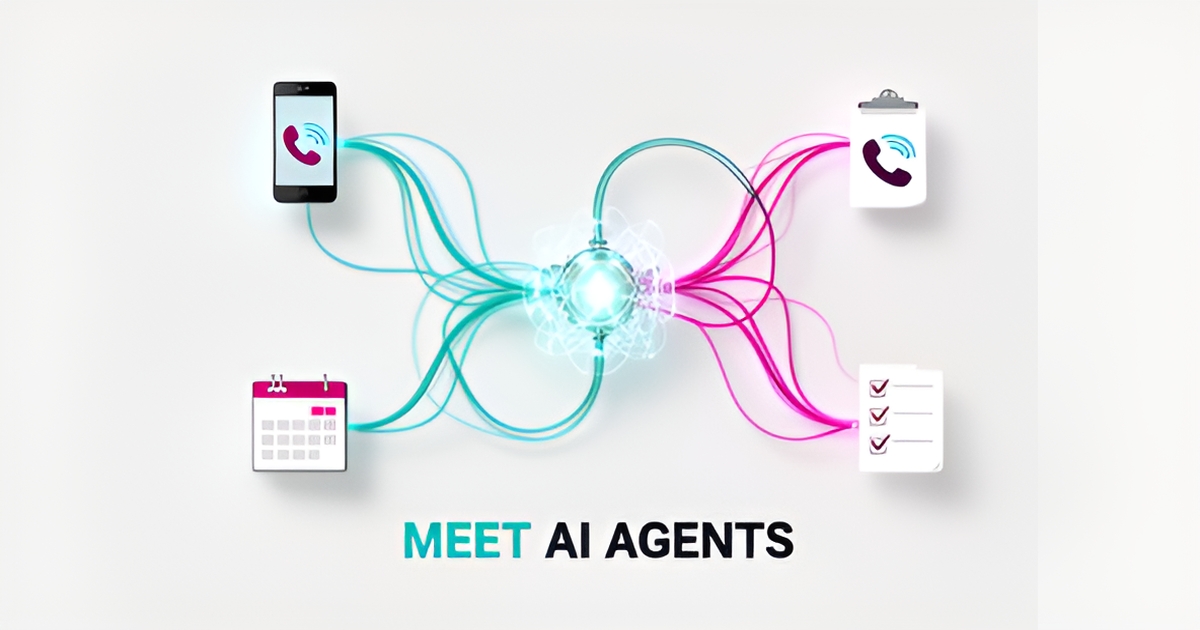
What Are AI Agents? Types, Examples & How They Work
Learn what AI agents are, the 5 types, how they work, and real AI agent examples for small business — plus how an AI receptionist answers and books for ...
What Are AI Agents? Types, Examples & How They Work
Key Facts
- ["42% of small businesses lose at least $500/month to missed calls, yet only 22% have adopted AI voice agents per Nextiva research", "The AI agents market is projected to grow from USD 7.84 billion (2025) to USD 52.62 billion (2030) at a 46.3% CAGR according to MarketsandMarkets", "McKinsey reports 40% of billion-dollar companies have scaled AI agents, up from 27% a year ago per McKinsey", "Gartner projects agentic AI will resolve 80% of common service issues by 2029, cutting operational costs by 30% per Nextiva/Nextiva research", "Telefónica's AI agents handled 4.5 million monthly calls with 90% intent accuracy per MarketsandMarkets", "32% of organizations declined buying software to build it in-house with agentic coding tools per McKinsey", "Wiley reported a 40% increase in case resolution using Agentforce per Salesforce"]
What Exactly Is an AI Agent?
If you've asked ChatGPT a question and gotten a paragraph back, you've used AI. If you've asked a system to book the appointment, check the calendar, send the confirmation, and log the lead while you were on a job site, you've used an AI agent. According to Google Cloud, AI agents are software systems that use AI to pursue goals and complete tasks on a user's behalf, showing reasoning, planning, and memory with enough autonomy to make decisions and adapt. That last part, the autonomy, is what separates agents from everything else you've been sold as "AI."
Most business owners have already met the weaker cousins of agents. A chatbot answers questions from a script or a document. Workflow automation follows a fixed path you set up in advance. An agent does neither. As Domo puts it, "An agent doesn't just answer your question. It figures out what needs to happen and makes it happen."
There's a simple test for telling them apart, and it's worth memorizing:
- The flowchart test: if you can draw the entire process as a flowchart before it runs, it's a workflow. If the system figures out the steps as it goes, based on what it learns, it's an agent.
- A chatbot responds to prompts. An agent is proactive and goal-oriented, deciding which tools to use and in what order.
- An agent maintains memory across tasks, so it doesn't start from zero every time a customer calls.
Under the hood, most modern agents work the same way. A large language model (LLM) acts as the brain, the same technology behind ChatGPT and Google Gemini. Around that brain sit a few components: a memory module that stores what's happened, a planning module that breaks a goal into steps, and a set of tools it can call, like a calendar, a CRM, or a phone line. IBM describes this as tool calling: unlike a traditional LLM, which is bounded by its training data, an agent reaches out for up-to-date information and creates subtasks on its own.
So what does this look like in a real small business? The most concrete example is the AI receptionist. A customer calls. The agent answers instantly, uses speech recognition to understand what the caller wants, checks real appointment availability, books the job, updates the CRM, and escalates to a human with full context if the request needs one. It's not a chatbot bolted onto a phone system; it's a system completing a multi-step task with judgment along the way.
The timing matters because the pain is real and the adoption gap is wide. Nextiva's research found that 42% of small businesses estimate losing at least $500 a month to missed calls, yet only 22% have adopted AI voice agents. Meanwhile, large enterprises are scaling agents fast: McKinsey reports 40% of billion-dollar companies now do, up from 27% a year ago. That's the gap this guide is about closing. At AI Business Sites, we've watched agents move from a technical curiosity to the working core of a small business's phone line, website, and follow-up, which is why the AI receptionist is the example we'll return to throughout this guide.
How Agents Think: The Operating Loop and Five Agent Types
What actually separates an AI agent from a chatbot is the loop it runs. Chatbots respond. Agents observe, think, plan, act, and learn, then repeat. As Domo puts it, "an agent doesn't just answer your question. It figures out what needs to happen and makes it happen." That loop is the engine behind every serious agentic AI system, from OpenAI's tool-using models to a AI receptionist service answering a plumber's phone at 7pm.
IBM breaks the cycle into three stages: goal initialization and planning, reasoning with available tools, and learning and reflection. In practice, an agent receives a goal, checks its memory and tools, plans the steps, executes them, and folds the results back in. The next run starts smarter. BCG describes the same cycle as observe–plan–act, and notes it becomes self-reinforcing as agents learn efficiency over time.
The five classic types of AI agents form a spectrum of sophistication. IBM and Domo converge on essentially the same taxonomy, though Google Cloud cautions that "there are different definitions of agent types and agent categories" across the industry, so treat this table as a framework rather than a universal standard.
| Agent Type | How It Decides | Strength | Limitation |
|---|---|---|---|
| Simple reflex | Fires pre-set rules on current input only | Fast, predictable | No memory, no context |
| Model-based reflex | Keeps an internal model of the world | Handles partial information | Model can drift from reality |
| Goal-based | Plans backward from a target before acting | Multi-step tasks | Slower; needs clear goals |
| Utility-based | Compares options and picks the highest-value one | Weighs tradeoffs (speed vs. cost) | Utility function must be defined well |
| Learning agent | Improves from feedback and experience | Gets better over time | Needs oversight and good data |
For a small business, the practical version is usually a goal-based agent with learning on top. An AI receptionist hears a call, identifies intent, books an appointment against real availability, logs the transcript to the CRM, and escalates to a human with full context when it's out of its depth. That matters because Nextiva's research found 42% of small businesses estimate losing at least $500 a month to missed calls, yet only 22% have adopted AI voice agents.
The takeaway: match the agent type to the job. A reflex agent can route a form. A learning agent can run your follow-up. And if you'd rather skip the build entirely, platforms like AI Business Sites deploy these agents for you, configured and managed, so the loop runs whether you're on a job site or not.
Why Small Businesses Need Agents Now
Artificial intelligence agents represent a fundamental shift in how software operates: they are systems that use AI, typically an LLM as the brain, to pursue goals and complete tasks on a user's behalf with a degree of autonomy, showing reasoning, planning, memory, and tool use. Unlike traditional chatbots that merely respond to prompts, agents can perceive their environment, make decisions, and execute multi-step actions to achieve a defined objective. Google Cloud defines the category as software systems that use AI to pursue goals and complete tasks with reasoning, planning, and memory, while BCG describes them as AI that use tools to accomplish goals with memory across tasks and the capacity to decide when to access internal or external systems on a user's behalf. The defining mechanism is an observe-think-plan-act-learn loop, where the agent perceives a situation, determines the necessary steps, takes action through available tools, and incorporates feedback to improve future performance. This architecture transforms agents from static rule-followers into adaptive problem-solvers capable of handling dynamic business challenges.
The rapid rise of agentic AI is reflected in explosive market growth and shifting adoption patterns. The AI agents market is projected to grow from USD 7.84 billion in 2025 to USD 52.62 billion by 2030, a compound annual growth rate of 46.3% according to MarketsandMarkets. Vertical domain-specific agents are the fastest-growing segment at 62.7% CAGR, followed by multi-agent systems at 48.5% and coding/software development agents at 52.4%. This growth is primarily driven by LLM integration, which is transforming agents from simple rule-based bots into autonomous, multi-step task performers. For small businesses, the urgency is underscored by McKinsey data showing that 40% of large enterprises have scaled AI agents, while smaller organizations remain flat at 22%, creating a significant enterprise-adoption gap that positions managed agent deployment as a practical bridge for SMBs seeking competitive advantage without the complexity of in-house development.
Small businesses face concrete pain points that agent technology is specifically designed to address. Research from Nextiva indicates that 42% of SMBs estimate losing at least $500 per month due to missed calls, yet only 22% have adopted AI voice agents, revealing a high-pain, low-adoption dynamic. Gartner projects that by 2029, agentic AI will resolve 80% of common service issues without human intervention, cutting operational costs by 30% and making conversational AI a standard expectation for 85% of customer service leaders. These statistics highlight a significant opportunity: the businesses losing the most to missed calls are the least likely to have automated solutions in place. The AI receptionist exemplifies this bridge, a voice agent that answers calls 24/7, understands caller intent, books appointments against real availability, and logs transcripts and summaries to the CRM, all while handling unlimited concurrent calls without the fatigue or overhead of a human receptionist.
For small business owners, the practical value of AI agents extends beyond answering phones. Agent types vary from simple reflex systems that respond instantly to current perceptions, to model-based agents that maintain an internal world state, to goal-based agents that plan sequences of action before acting, and utility-based agents that maximize a utility function across competing options. Multi-agent systems coordinate specialized agents to tackle complex workflows, such as a booking agent paired with a knowledge agent and a scheduling agent. Real-world examples abound: Telefónica's AI agents handled 4.5 million monthly calls with 90% intent accuracy, while Cencora achieved fourfold faster verification turnaround. For a small business, the application is equally tangible, an AI receptionist can qualify leads, schedule consultations, and capture customer information during a single call, freeing the owner to focus on delivery rather than administration. The technology's ability to maintain memory across sessions means returning callers are recognized, their history is surfaced, and the experience feels continuous rather than repetitive.
The enterprise adoption data reveals both momentum and barriers. McKinsey reports that 88% of organizations use AI in at least one business function, and 62% are experimenting with AI phone agents specifically, yet nearly 60% of enterprises cite non-compliance risks and data governance concerns as key barriers to wider adoption. High performers, just 6% of respondents, reach this status by fundamentally redesigning workflows rather than simply inserting AI into existing processes, suggesting that the technology's value scales with process maturity. For small businesses without dedicated IT teams, this reinforces the value of a done-for-you approach: the AI Business Sites model delivers agent functionality through a managed platform that handles hosting, integration, training, and ongoing optimization, eliminating the technical project burden while providing the productivity and cost-saving benefits that larger enterprises have already begun to realize.
Real-World Results and Honest Limitations
The numbers behind AI agents are impressive, but they deserve a closer look. Telefónica's AI agents now handle 4.5 million monthly calls with 90% intent accuracy, Wiley reported a more than 40% increase in case resolution using Agentforce, and an IBM deployment cut contract review time from 90 minutes to 45 by routing work between specialized agents. These are real, measurable results, not demos.
But the same sources that celebrate these wins are honest about where agents fall short. Google Cloud itself notes that AI agents struggle with tasks requiring deep empathy, such as therapy or social work, and with high-stakes ethical decisions like those in law enforcement or the judiciary. They also struggle in unpredictable physical environments, and building them is resource-intensive enough that Google flags it as potentially unsuitable for smaller budgets.
Then there's the governance problem. Nearly 60% of enterprises cite non-compliance risks and data governance concerns as key barriers to adopting agents at all. When software can act on its own, someone has to answer for what it does. BCG puts it plainly: even when agents follow their instructions and stay within their permissions, they can still cause harm.
This is why the human-in-the-loop approach matters, and it's the principle we build around at AI Business Sites. Every customer-facing action our agents take, from drafted review replies to published content, can pass through an approval queue where you see the AI's reasoning and accept, edit, or reject it. The agent does the work; you keep the final call. That matches what experienced practitioners report: AI is a tireless junior teammate, but senior judgment stays with the human.
For a small business owner, the practical takeaway is simple. The results are real when agents handle well-defined, repetitive work: answering calls, booking appointments, following up on leads. The risks are real when agents are asked to replace human judgment on anything sensitive or high-stakes. Put agents where they're proven, keep a human where it counts, and you get most of the benefit without most of the exposure.
Frequently Asked Questions
What exactly is an AI agent and how does it differ from a chatbot?
What are the main types of AI agents and how do they differ?
How can a small business use AI agents in practice?
What are the risks and limitations of using AI agents?
What is the ROI for small businesses using AI agents like AI receptionists?
How do AI agents learn and improve over time?
From Curiosity to Competitive Edge
AI agents aren't a future technology, they're software systems that reason, plan, remember, and act on your behalf, and the businesses adopting them now are pulling ahead. The numbers make the stakes clear: 42% of small businesses estimate losing at least $500 a month to missed calls, yet only 22% have adopted AI voice agents, while 40% of billion-dollar companies are already scaling agents. The gap between big and small business is where opportunity lives. Start with the work agents are proven at: answering calls, booking jobs, following up on leads, the repetitive, high-volume tasks that quietly drain your revenue. Keep human judgment where it counts. You don't need to build the technology yourself; you need a system that runs it for you. Ready to put AI agents to work in your business? Explore AI Business Sites' AI receptionist service and website builder to automate bookings, calls, and customer follow-up today.