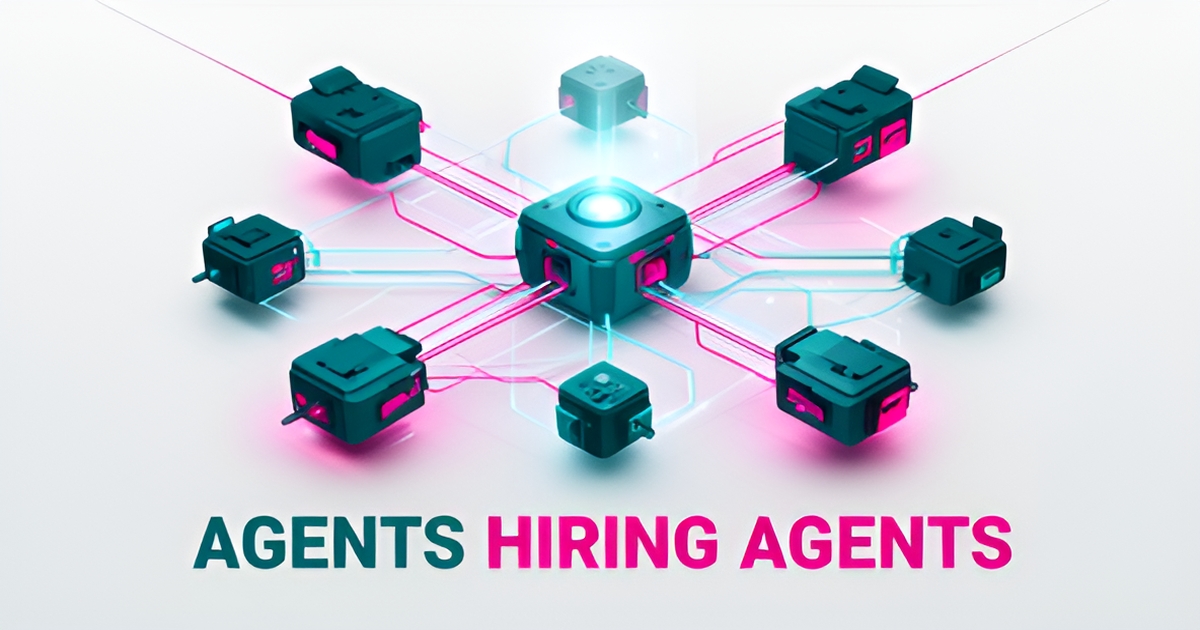
Software That Hires Software: What the Agent-to-Agent Economy Means for Small Business
Software agents are already dispatching work to other software agents inside real small businesses. Here's what the agent-to-agent economy actually looks like at ground level, and who should be managing it.
Strip away the jargon and an AI agent is just software that takes a task, decides how to do it, and does it. The moment you have two of them handing work back and forth, you have an agent-to-agent system. Consider a loop many service businesses run daily. A customer calls and a voice agent answers, producing a transcript. That transcript is handed to an assistant agent, which drafts a line-item quote with quantities, tax, and a validity date. The owner approves it from a phone. The customer signs it online, and the approval automatically creates a job card on a scheduling board. When the job finishes, an invoice agent sends the bill with a payment page, then fires day-3, day-7, and day-14 reminders until it's paid. A review request follows. No single piece of software did all of that. Several specialized systems did, each one triggering the next. That's the agent-to-agent economy, arriving through the back door of a quote-to-invoice loop rather than through an enterprise procurement platform.
The reason businesses run multiple specialized agents instead of one general assistant comes down to quality and accountability. A production content pipeline, for example, works better when one agent researches, another pulls statistics, another drafts, and others verify claims, check citations, add schema markup, and format for search engines. Twelve narrow jobs done well beat one broad job done adequately. The same logic applies to SEO. A working SEO system isn't a magic "rank me" button; it's a weekly loop where an analyst measures traffic and rankings, a strategist picks keywords using real volume and difficulty data, a brief writer packages targets, an editor rewrites decaying pages, and a reporter files a summary the owner can actually read. Each role is inspectable. You can see what ran, what changed, and why. That transparency is what makes autonomous software trustworthy enough to operate a business. When a system can show you every agent run, with timers and stage-by-stage timelines, autonomy stops being a leap of faith.
The technical backbone of agent-to-agent commerce is interoperability, and the protocol getting the most traction is MCP, an industry standard for connecting external tools and APIs to an AI assistant. Here's the part most coverage misses: a small business benefits from the same protocol a Fortune 500 uses, and for the same reason. If your assistant can speak a standard protocol, your accounting tool, your supplier's ordering portal, or your industry's scheduling system can plug in without anyone building a custom bridge. The catch is that somebody still has to do the connecting. The owner of a three-truck HVAC company is not going to read protocol documentation between service calls, and they shouldn't have to. This is where the DIY argument falls apart. The underlying engines, including the open-source ones, are free. But hosting them, wiring them to your website and calendar and CRM, teaching them your business, and keeping them running is a technical project, not a Tuesday. Free is only free if your time is.
The executive-playbook framing of the agent economy usually skips the most important question for a small business: who supervises all this software? Agents drift. They make confident mistakes. They draft an email that's 90 percent right and 10 percent wrong in a way that costs you a customer. A serious system needs governance built in, and the practical version of governance is human-in-the-loop approval with confidence scoring. Every customer-facing draft, whether it's an email, a social post, a review reply, or a blog article, should sit in a review queue with a score attached. High confidence can auto-publish; low confidence waits for a human. When a human rejects a draft, that rejection should teach the system, so the next draft is better. Rejection feedback as a training loop is the difference between an agent workforce that improves and one that keeps making the same mistakes. There's also a supervision layer above individual drafts. The best setups give the owner a single ranked list of everything in the business waiting on a human: approvals pending, failed tasks, missed calls, unread threads. The software manages the software, and the owner manages only the exceptions.
The most underrated development in this space is that agents now study their own results and adjust. Outbound campaigns can run champion-versus-challenger message variants, score replies by real outcomes, and let a nightly research pass propose one careful mutation at a time to the winning copy. Social content systems can mine what actually performs in a niche, extract hook patterns that proved out, and run A/B experiments that conclude on impression thresholds, writing winners back into a reusable library. This is software hiring software in the fullest sense: a strategist agent commissioning research, a judge agent gating quality, a researcher agent proposing improvements based on field data. None of it requires the business owner to prompt anything. They approve concepts on Monday, and the machine does the rest of the week. For an owner who will never sit down to write a blog post or study engagement analytics, that's the entire point.