An Award for AI-Assisted App Development Raises the Question Small Businesses Should Actually Ask
AI-assisted development is now award-worthy. But a faster build doesn't run your business. Here's the question small business owners should ask before hiring anyone.
Mobulous, founded in 2013 and headquartered in Noida, India, develops native iOS and Android apps plus cross-platform work in Flutter and React Native. Its services also cover AI integration, custom software, web development, and SaaS builds, across verticals including healthcare, fintech, e-commerce, logistics, education, real estate, and travel. The "AI-assisted" part of the award refers to how the firm builds. According to the company's announcement, its engineers use tools like Lovable, Claude Code, and Cursor for prototyping and iteration, while human engineers keep oversight of architecture, integrations, security, QA, and deployment. The company is also listed in the Lovable Partner Directory, which has become a credential signal for agencies that convert AI-generated prototypes into production software. On paper, the firm carries ISO 9001:2015, ISO/IEC 27001:2022, and CMMI Maturity Level 3 credentials. One caveat worth stating plainly: this is a company-issued press release, syndicated to outlets like India Morning Times and MENAFN. There's no independent journalism behind it, and awards of this type are frequently nomination- or submission-based rather than independently juried. Treat the claims as company-reported, which is fine as long as you know what you're reading. That said, the underlying trend is real and worth paying attention to.
What Mobulous is doing reflects where the whole development services market has moved. The current generation of AI coding and prototyping tools, the same ones named in the release, has become standard equipment at agencies. Firms that used to sell hours now sell faster hours, and they're branding it accordingly. "AI-assisted engineering" is showing up in pitch decks, award submissions, and partner directories as a differentiator. The messaging formula is telling. Notice how carefully the announcement balances enthusiasm with reassurance: AI accelerates the work, humans govern the security, architecture, and deployment. That's the dominant enterprise message of this period, and it works because buyers have two fears at once. They fear being left behind by AI, and they fear being burned by it. The "AI accelerates, humans verify" framing addresses both. If you're hiring a development shop in 2026, this is the baseline you should expect. Ask any vendor claiming AI-assisted development which tools they use, where the human review happens, and who's accountable when an AI-generated component fails in production. A shop with a real answer, like the one this release describes, is a better bet than one waving the AI banner without a process behind it.
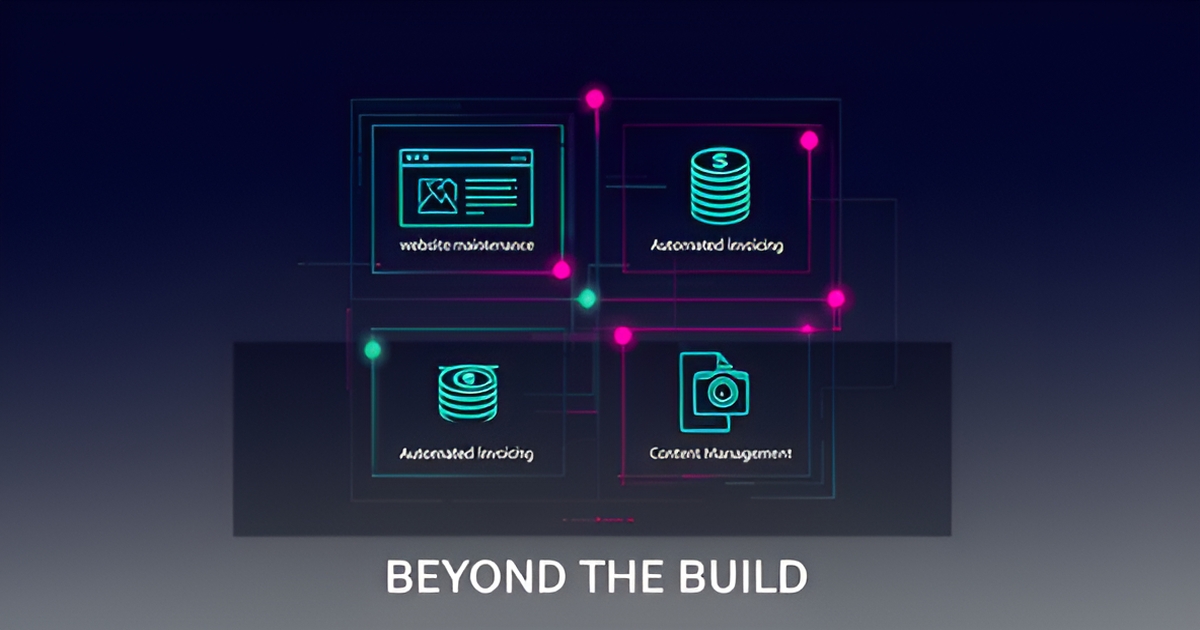
Here's the gap. An award for AI-assisted development is an award for building software. It says nothing about what happens after the build ships, and that's where most small businesses actually struggle. A custom development project, no matter how efficiently it's assembled, hands you an artifact. You get an app or a website. Then the real work begins: answering customer questions, following up on leads, publishing content so Google notices you, sending quotes, chasing invoices, requesting reviews, keeping the calendar full. A faster build doesn't touch any of that. Someone still has to do it, and at most small businesses, that someone is the owner, at 9 p.m., when they'd rather be doing anything else. There's also the maintenance question. Custom dev work often leaves the client dependent on the shop that built it. Every change, every fix, every new page goes back through the vendor's queue and the vendor's invoice. The software gets built once, but the business runs every day, and the running is what costs money and time. The "AI accelerates, humans verify" framing has an interesting parallel beyond development, too. The same principle applies to how a business should operate day to day: AI drafts the quote, the owner approves it from their phone. AI writes the blog post, a human checks it before it publishes. AI answers the phone, the transcript and summary land in the CRM for review. Governance isn't a compromise on AI's value; it's what makes AI safe enough to actually hand real work to.
The pricing model is where the difference becomes concrete. A custom dev shop sells a project: a scope, a timeline, a final invoice, and then an ongoing retainer if you want changes. That model makes sense for a company with a CTO and a product roadmap. For a plumbing contractor, a salon, or a restaurant owner, it's a poor fit. They don't have a product roadmap. They have customers who call and expect an answer. The alternative that's emerged is a managed, done-for-you model: one flat monthly fee, and a team, human plus AI, builds the website and then operates the business systems behind it. The content gets written and published every month without the owner lifting a finger. The leads get captured and followed up automatically. The quotes go out, the invoices collect themselves, the review requests go after payment. The owner's job is to run their trade; the system runs the rest. When you compare the two, the honest framing is this: a dev shop like Mobulous and a managed AI platform aren't really competitors. They solve different problems for different buyers. But if you're a small business owner evaluating both because you know you need "something with AI," the deciding question is simple. Do you need software built, or do you need your business run? If it's the second, an award for fast building, however impressive, isn't the credential you're shopping for.
Whether you end up hiring a custom shop or a managed platform, a few checks will save you grief: Ask who owns the output. Code, content, data, domain. If you leave, what do you walk away with? A vendor confident in its work hands you your assets on the way out; a vendor that locks you in is renting you your own business. Ask what happens after launch. Who writes the content, chases the leads, and maintains the site? "You do" is a legitimate answer at some firms, but you should know it before you sign, not after. Ask where humans sit in the loop. The best AI systems of 2026, in development and in business operations alike, put AI on the drafting and speed work and humans on approval and accountability. If a vendor can't articulate that boundary, they haven't thought about it. And take awards for what they are. A recognition like the one Mobulous received tells you a company is marketing itself well and moving with the industry. It doesn't tell you what your experience as a client will be. Only references, a clear contract, and an ownership guarantee do that.